

Preply Commission Rate 2026: How Much Tutors Actually Keep
Preply just hit unicorn status — a $150M Series D and a $1.2B valuation, on the back of 100,000+ tutors teaching in more than 90 languages. Tutors funded a meaningful share of that. Here's exactly how much, and what it means for how you build your teaching income.
Key takeaways
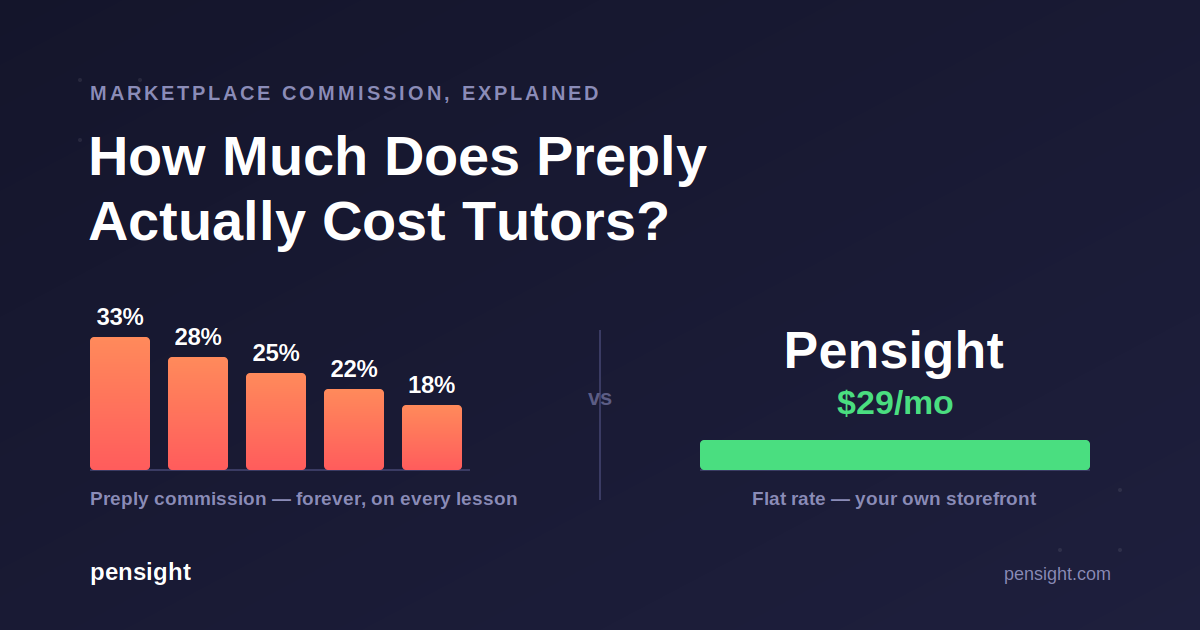
- Preply charges tutors a sliding commission of 18–33% depending on total hours taught, and takes 100% of every trial lesson with a new student.
- A tutor charging $35/hour hands over roughly $2,200 a year at the entry tier. The rate drops as you teach more, but it never goes away.
- The commission isn't the real ceiling. A marketplace can only sell one product — your time.
- The language coaches earning $5,000–$10,000 a month run a second revenue layer — courses, group programs, memberships — on a platform they own, such as Pensight, at $29/month flat.
How Preply's commission actually works
Preply uses a tiered commission model tied to how many hours you've taught on the platform, total — not per student. Here's the current structure, showing what you keep on a $35/hour lesson:
- Trial lesson (every new student) — 100% commission. You keep $0.00.
- 0–20 hours — 33% commission. You keep $23.45.
- 20–50 hours — 28% commission. You keep $25.20.
- 50–200 hours — roughly 25% commission. You keep $26.25.
- 200–400 hours — roughly 22% commission. You keep $27.30.
- 400+ hours (floor rate) — 18% commission. You keep $28.70.
A few details that catch new tutors off guard:
- The trial lesson is free to you, every time. Every new student's first lesson pays Preply 100% of the fee. If a student books a $35 trial, you receive $0 for teaching it.
- Hours are cumulative across the platform, not per student. Trial lessons count toward your total, so they at least move you toward the next tier.
- The 18% floor takes a while to reach. At 400+ hours, teaching around 20 hours a week, that's roughly five months of full-time-ish teaching before you hit the best rate — and you're still giving up nearly a fifth of everything.
(Rates current as of Preply's published commission model as of mid-2026 — commission structures can change, so confirm the latest tiers directly with Preply before making decisions based on these figures.)
What that commission actually buys you
To be fair to Preply: 33% of something is better than 100% of nothing. If you're a new tutor with no audience of your own, Preply's commission is the price of access to a marketplace of students actively looking for lessons, plus the tooling — booking, payments, video classroom, dispute handling — that would otherwise take real time and money to build yourself.
For a tutor just starting out, that trade is often worth it. The question isn't whether Preply's cut is "fair" in the abstract — it's whether the commission is still buying you something once you're not new anymore.
Already have regular students?
Pensight gives you the same tools — booking, package tracking, payments, and soon AI session follow-ups — on your own page for $29/month flat. Keep tutoring sites for new students; run your regulars yourself.
See how language teachers run their 1:1s on Pensight →
The real math
Let's run the numbers for a tutor charging $35/hour with 4 regular students, each taking one lesson a week — about 16 lessons a month, $560 in gross bookings.
- As a new tutor (33%) — Preply takes $184.80/month. You keep $375.20/month. That's roughly $2,218 a year in commission.
- As a veteran (18%, 400+ hours) — Preply takes $100.80/month. You keep $459.20/month. That's roughly $1,210 a year in commission.
And that's without counting the free trial lesson each new student costs you — at this rate, roughly $140 in unpaid teaching time to land each new regular student.
For comparison, running the same $560/month of bookings through your own storefront (Pensight Pro, $29/month flat, plus a roughly 3% Stripe processing fee) costs about $45.80 in total — leaving you around $514.20. Against $375.20 as a new Preply tutor, that's a difference of roughly $139 a month, or $1,670 a year.
The honest caveat: Preply found those four students for you. On your own storefront, you bring your own audience — the platform doesn't hunt for you. That's the actual trade you're making, and it's why the answer usually isn't "leave Preply," it's "don't let Preply be the only place your income can come from."
How Preply compares to the other language marketplaces
Preply has the highest entry commission of the major platforms, but it's also the only one whose rate improves with volume. If you teach on more than one, the maths differs meaningfully:
- italki reportedly charges around 21% on single lessons, with no tiers to climb. Full breakdown of italki's commission →
- Verbling takes a flat 15% — the lowest rate in the category, with no trial-lesson clawback. Why the lowest cut still has a ceiling →
- カフェトーク (Cafetalk), the largest Japanese-market platform, starts teachers at a 40% margin. カフェトークの手数料の詳細 →
The ceiling a marketplace profile can't remove
Even at the best commission tier, a marketplace caps your income at hours × rate. There's a hard ceiling on how many hours you can personally teach in a week, and no version of Preply lets you sell a self-paced course, run a group cohort, open a membership, or build an email list of your own students. Every dollar you earn there is still tied to a lesson you personally show up for.
That's the real gap between tutors earning a comfortable side income and the ones running $5,000–$10,000/month teaching businesses. It's rarely a higher hourly rate. It's a second revenue layer — courses, group programs, community — that doesn't require trading another hour for another dollar.
A dual-track model, not a switch
The most sustainable setup we see isn't "quit Preply" — it's running two tracks at once:
- Marketplace-only. All income depends on hours taught and Preply's acquisition engine. Fine for starting out; a ceiling long-term.
- Marketplace + owned products. Keep teaching on Preply for steady student flow, while building a course, a group program, or a membership on a platform you control. This is where most full-time coaches land.
- Owned-first. The marketplace becomes optional — a top-of-funnel channel, if you use it at all — because your own audience and products carry most of the revenue.
You don't need to leave Preply to start stage two. You need somewhere to put the parts of your business a marketplace was never built to hold.
Marketplace vs. your own platform, side by side
What a marketplace like Preply gives you, and what it can't:
- Finds students for you — Marketplace: yes, that's the core value. Your own storefront: no, you bring your own audience.
- Ongoing cost — Marketplace: 18–33% of every lesson, forever, plus 100% of trial lessons. Your own storefront: $29/month flat, plus a ~3% Stripe payment-processing fee on transactions.
- Who owns the student relationship — Marketplace: the platform. Your own storefront: you.
- Selling courses — Marketplace: not possible. Your own storefront: yes.
- Group programs and memberships — Marketplace: not possible. Your own storefront: yes.
- Building an email list — Marketplace: not possible. Your own storefront: yes.
- Income model — Marketplace: hours × rate, capped by your calendar. Your own storefront: products and programs, uncapped.
Disclosure: we build Pensight, one of the tools in that second column. We've tried to keep the commission figures above accurate and sourced regardless.
FAQ
How much commission does Preply take from tutors?
Preply's commission runs from 33% for new tutors down to 18% for tutors with 400+ hours taught on the platform, plus 100% of every trial lesson with a new student.
Does Preply really keep 100% of the first lesson?
Yes. Every trial lesson with a new student pays the tutor $0, regardless of commission tier. This applies to every new student pairing, not just your first ever trial.
How long does it take to reach Preply's lowest commission tier?
Reaching the 18% floor requires 400+ cumulative hours taught, which takes roughly five months at 20 hours a week.
Which language marketplace takes the smallest cut?
Verbling, at a flat 15%, followed by italki at a reported 21% on single lessons. Preply is highest at entry but its 18% floor is the lowest of the three for very high-volume tutors.
Can I sell courses or group programs through Preply?
No — Preply's platform is built around 1:1 lesson bookings. Courses, group programs, memberships, and email marketing require a separate platform.
Is it against Preply's rules to have my own website or storefront?
No. Running your own teaching business alongside your marketplace profile is fine — the line is taking students Preply brought you off-platform to avoid paying commission on lessons you owe them for. Courses and programs for your own audience are a separate business.
What do full-time language coaches typically use alongside a marketplace?
Most combine marketplace teaching (for steady student flow) with their own storefront for courses, group coaching, memberships, and email marketing — the parts of the business a marketplace doesn't support.
Want to build the layer a marketplace can't hold? See how language teachers run 1:1s on Pensight →
A note on accuracy: commission rates and tier thresholds are set by each marketplace and can change. The figures above reflect Preply's publicly available commission policy as of mid-2026 — confirm current rates directly with Preply before making financial decisions.


